
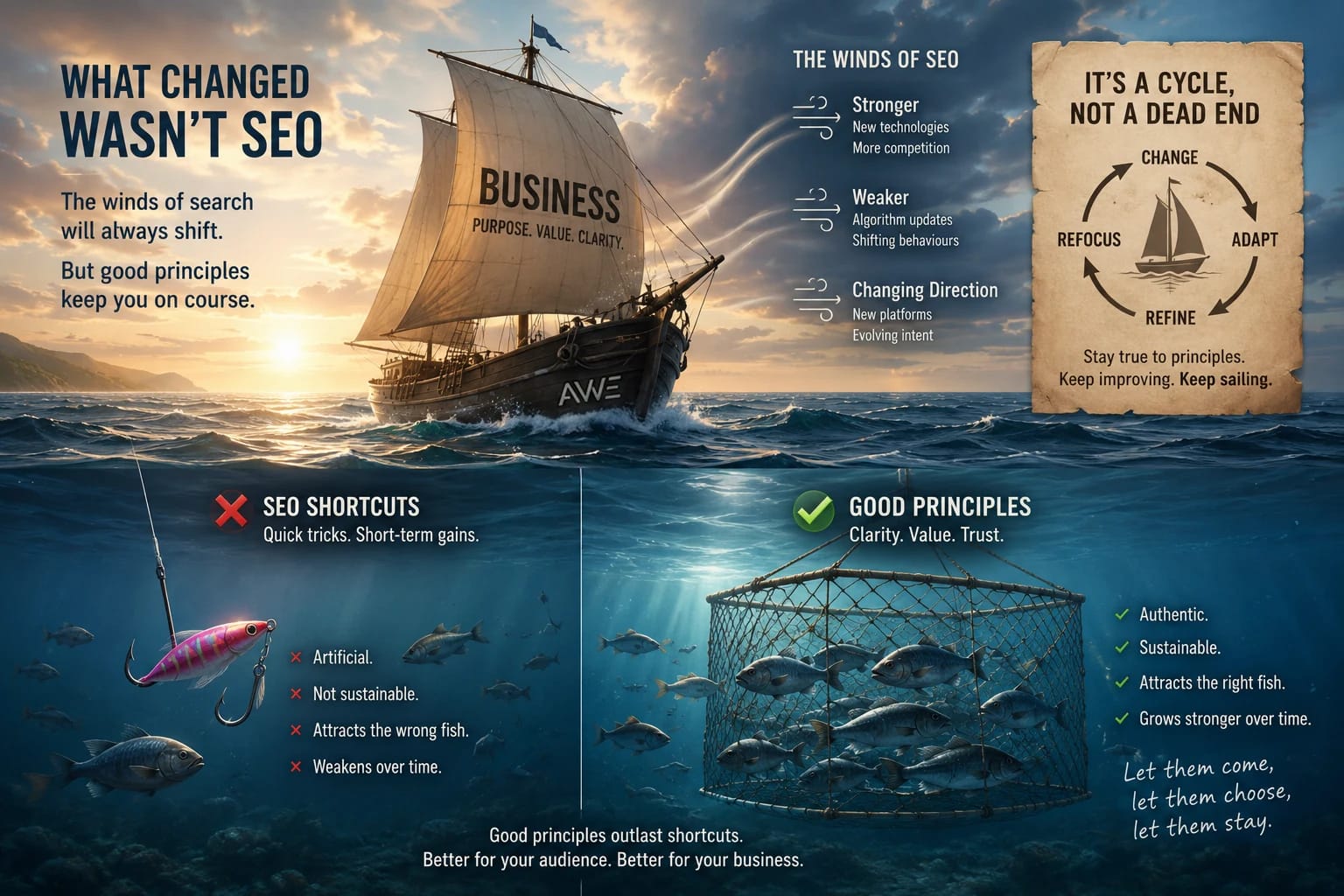
Good Principles Outlast Shortcuts
If you’ve been following SEO discussions lately, you could be forgiven for thinking everything has changed.
AI has arrived. Google has evolved.
AI Overviews are appearing in search results.
Ranking fluctuations continue.
And every week seems to bring a new strategy promising to “adapt to the future.”
Yet when I step back and look at what is actually happening, I keep arriving at a different conclusion:
What changed wasn’t SEO.
What changed was the effectiveness of shortcuts.
For years, websites could often gain visibility through tactics that delivered little real value to users.
Large text walls packed with keywords.
Backlinks from almost anywhere.
Thin content pages created primarily for search engines.
Writing designed to rank rather than help.
Many of these approaches worked because search engines were still learning how to evaluate quality at scale.
Today, that is becoming increasingly difficult.
Not because Google or AI suddenly invented new principles.
But because they are becoming better at recognising the principles that always mattered.
- Clarity.
- Relevance.
- Usefulness.
- Trust.
- Authority.
- Structure.
These are not new ideas.
- Good user experience has always depended on them.
- Good conversion has always depended on them.
- Strong businesses have always depended on them.
What is changing is the level of importance being placed on them.
A clear page that quickly answers questions is easier for users to understand.
A well-structured article is easier for search engines and AI systems to interpret.
A business that demonstrates genuine experience and expertise is easier to trust.
Interestingly, many of the concepts now being discussed under EEAT, AI visibility, and answer engine optimisation have strong overlaps with principles that conversion specialists, UX practitioners, and content strategists have been discussing for years.
People don’t want to work hard to understand what you do.
- They don’t want to navigate confusion.
- They don’t want to search through unnecessary information.
- They want clarity.
- They want to understand your value in under five seconds.
In many ways, the current evolution of search is simply increasing the reward for providing it.
This is one reason why I often view SEO, conversion, trust, and user experience as connected disciplines rather than separate activities.
The underlying goal is remarkably similar:
- Help the right person understand the right information at the right time, and the value your business can provide to them.
The tools and platforms may change.
The algorithms may change.
The shortcuts certainly come and go.
But good principles tend to survive.
And perhaps that’s the most important lesson from recent search changes.
Not that SEO became obsolete.
But that clarity became harder to avoid.
Not that AI replaced good optimisation.
If anything, AI systems are increasingly rewarding the same qualities people have always valued: clarity, relevance, usefulness, and trust.
Because in the long run:
- Good principles outlast shortcuts.
- And they usually create better businesses too.
🔗 Follow AWE on LinkedIn: https://www.linkedin.com/company/awe-conversion
🔹 Follow the discussion on Facebook for daily AWE strategies: https://www.facebook.com/awe.conversion