
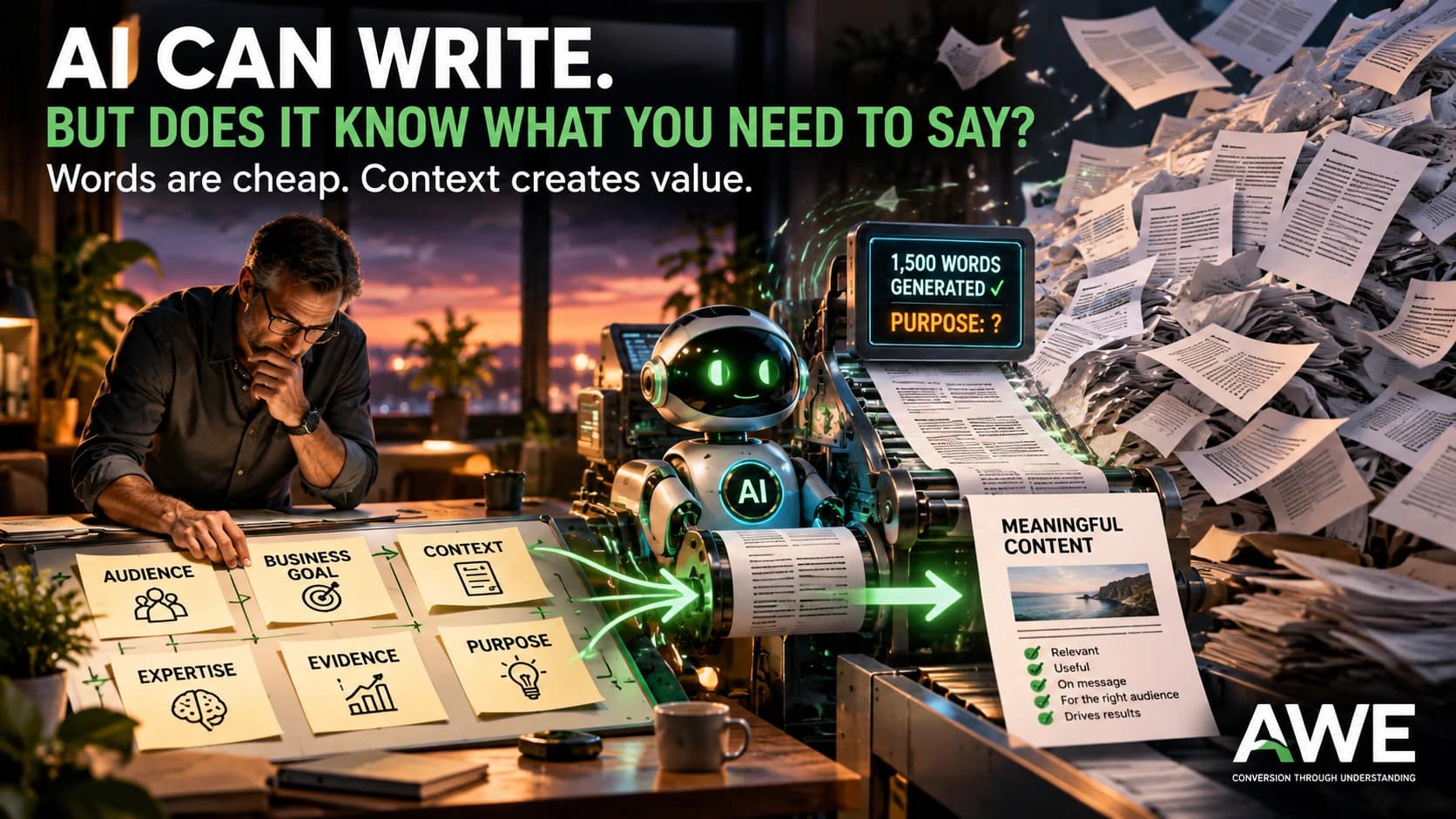
AI Can Write. But Does It Know What You Need to Say?
There’s a lot of anxiety around AI and content.
Will AI replace content writers? Do businesses still need SEO specialists and marketers when an AI can produce 1,500 reasonably convincing words before I’ve finished making a cup of tea?
Earlier this week I read Andrew Holland’s Search Engine Land article, The Future of Content Isn’t Writing. It’s Thinking.
His argument resonated with me: AI has made producing words remarkably cheap. That doesn’t eliminate the value of content expertise. It shifts the value towards ideas, experience, judgement and knowing what is actually worth saying.
And that got me thinking.
Producing Words Isn’t the Same as Communicating
AI can produce text extraordinarily quickly.
Wonderful.
But what was that text supposed to accomplish?
A business doesn’t need another 1,500 words simply because Google might index them.
It needs content that helps the right person understand something, solve something, trust something or make a decision, ideally one that also contributes towards a meaningful business outcome.
That still requires someone to understand:
What are we trying to achieve?
Who are we trying to help?
What do they need?
What do we actually know?
And what is worth saying?
Making words cheaper hasn’t made those questions disappear.
Perhaps it has made them more important.
Does Intelligence Have to Think Like Us?
Coincidentally, this week I also watched The Imitation Game.
One exchange about Alan Turing’s work stayed with me: if a machine thinks differently from a human, does that necessarily mean it isn’t thinking?
The dialogue was written for the film, but Turing posed essentially that question himself in his 1950 paper Computing Machinery and Intelligence:
“May not machines carry out something which ought to be described as thinking but which is very different from what a man does?”
That’s particularly interesting to me because my own introduction to AI came while studying an AI degree back in the 1990s.
AI wasn’t merely about programming. It took us into philosophy, psychology and linguistics because before trying to reproduce aspects of intelligence computationally, we first had the need of understanding what intelligence actually is.
Descartes: I think, therefore I am.
But does something have to think like me to be useful?
Perhaps we’re asking the wrong question.
I don’t need an AI to experience the world exactly as I do.
I need to understand what it’s exceptionally good at, where its limitations lie, and how those capabilities can complement human knowledge and experience.
Language Is Both the Strength and the Limitation
This becomes especially interesting with Large Language Models.
The clue is in the name.
Language.
Lao Tzu opens the Tao Te Ching with an idea that has survived for more than two millennia: the Tao that can be expressed in words isn’t the eternal Tao.
Words describe reality.
They aren’t reality itself.
An LLM can explain grief. It can draw upon an extraordinary amount of human language describing grief and perhaps help someone express it.
But it hasn’t buried somebody it loved.
That doesn’t make its capability worthless. It tells us what kind of capability we’re working with.
And for website content, where language is precisely how a business communicates much of what it does, that’s an extraordinarily useful capability.
If we give it something worth working with.
Garbage In. Beautifully Written Garbage Out.
Give an LLM a vague objective, generic information and no meaningful understanding of the business or audience and it can produce beautifully structured generic content at breathtaking speed.
But again:
What was the content supposed to accomplish?
Imagine you’re selling pastizzi.
If your proposition is the cheapest pastizzi in Malta, reaching thousands of people searching for cheap pastizzi might be excellent.
If you’re selling gourmet pastizzi at five times the price, ranking brilliantly for the same search might produce magnificent traffic numbers, and lots of people immediately leaving.
The metric improved. Did the business?
And if your beautifully optimised AI content makes your Maltese visitor mutter something involving male anatomy within five seconds and disappear, congratulations:
Your SEO brought you another visitor.
Perhaps keep the champagne cork in until we see whether anybody bought anything.
AI Doesn’t Eliminate Expertise
This is where I think the fear of AI replacing specialists misses something important.
AI can increase the value of expertise as an input.
Part of my work involves collaborating with people already working inside businesses, marketers, content people, developers and business owners.
Increasingly, that includes helping people use AI within the expertise they already possess.
My advice isn’t: “Let AI write it.”
It’s along the lines of:
Give it your knowledge.
Give it the business context.
Give it the audience.
Give it the objective.
Give it evidence.
Then use your expertise to judge what comes back.
The content specialist still understands tone, audience, emphasis and subject matter.
They recognise when something technically correct sounds ridiculous.
They know when something doesn’t sound like the business.
And they can recognise beautifully written content that completely misses the point.
Typing may occupy less of their time.
Thinking shouldn’t.
The Value Moves
That’s perhaps the real change.
AI can reduce the time spent physically producing sentences.
That moves more of the valuable work upstream into research, expertise, ideas, audience understanding and strategy, and downstream into judgement, verification, editing and learning from what actually happens.
Search Engine Land puts this as the value moving from production towards thinking.
I’d add one thing:
Good thinking needs good context.
Having the ability to produce ten times more content doesn’t mean publishing ten times more content is a good idea.
Sometimes expertise still means saying:
“Don’t publish that.”
AI Isn’t the Hero or the Villain
AI isn’t Voldemort.
It isn’t Darth Vader.
And it isn’t Harry Potter or Luke Skywalker coming to save your marketing department either.
It’s a different kind of capability.
Give it vague objectives, generic knowledge and no meaningful context and don’t be surprised if you end up with the linguistic equivalent of a dodgy droid or a confused troll.
Give it expertise, evidence, context, purpose and a clearly understood audience, and put somebody who knows what they’re doing in the pilot’s seat, and you’ve got something rather closer to the Millennium Falcon.
Still occasionally temperamental.
Still capable of getting things spectacularly wrong.
But in the right hands, bloody useful.
The future of content may involve considerably less time typing.
That doesn’t mean it requires less thinking.
Perhaps quite the opposite
🔗 Follow AWE on LinkedIn: https://www.linkedin.com/company/awe-conversion
🔹 Follow the discussion on Facebook for daily AWE strategies: https://www.facebook.com/awe.conversion