A Business Problem Doesn’t Care What Department Solves It
A website has an SEO problem.
Or does it?
Perhaps the page isn’t being discovered because its topic isn’t clear.
That’s SEO.
Perhaps the topic is clear, but it’s attracting people the business doesn’t actually want.
Now we’re moving into audience understanding and business strategy.
Perhaps they’re exactly the right people, but the proposition isn’t clear.
That’s copy, UX and conversion.
Perhaps they understand it but can’t complete the journey efficiently.
Now we’re into UX, development and potentially software engineering.
Perhaps everything works beautifully individually, but the pieces don’t work together.
That’s a systems problem.
Where exactly did SEO finish and CRO begin?
Sometimes we better ask if this is the right question.
We Create Disciplines. Problems Don’t.
We’ve become very good at dividing digital work into specialist boxes:
- SEO
- CRO
- UX
- Web development
- Software development
- Analytics
- AI
- Marketing strategy
Those distinctions are useful.
They allow people to specialise, develop expertise and communicate what they do.
But the customer experiencing a business doesn’t experience an SEO department followed by a UX department followed by a development department.
They experience one system.
- Search brings an expectation.
- The page either satisfies or contradicts it.
- The interface helps or obstructs them.
- The technology works or doesn’t.
- The proposition makes sense or doesn’t.
- Their previous experiences influence whether they trust it.
And somewhere behind all of this sits a business trying to achieve an outcome.
The boundaries between our disciplines are considerably clearer on an organisational chart than they are in reality.
Why AWE Doesn’t Fit Neatly Into One Box
My own route into optimisation hasn’t exactly followed a neat marketing career ladder.
It includes web and software development, AI, Agile and Scrum, systems thinking, SEO, conversion optimisation, topic and search analysis, analytics, critical thinking and creative problem-solving.
Not because I’ve tried to become a master of everything, but because I’ve followed where work, problems and life have taken me – accepting and learning from each experience along the way.
On paper, that’s quite a collection.
In practice, they keep demonstrating just how interconnected things really are.
Software engineering encourages me to think about architecture, dependencies and failure.
Agile taught me to work iteratively rather than assume the first solution is correct.
Systems thinking asks what happens to the whole when one component changes.
SEO provides evidence about discovery, queries, topics and expectations.
Analytics provides evidence about what happens afterwards.
CRO asks whether the experience helps the right person progress towards an appropriate outcome.
AI can help us analyse considerably more evidence.
Yet, more analysis doesn’t remove the need to use your bloody mind!
Ask sensible questions. Exercise judgement. Apply real experience and skill.
Critical thinking asks whether our conclusion actually follows from what we’ve observed.
Creative thinking asks whether there’s another way of solving the problem entirely.
None replaces the others.
Their value comes from interaction.
Capabilities Aren’t the Starting Point
This is why I’m increasingly uncomfortable with beginning an engagement by deciding: “This business needs SEO.”
Maybe.
But first:
What is the business trying to achieve?
Who is it trying to help?
What is preventing that from happening?
What does the evidence actually show?
Only then does it make sense to ask which capabilities might help.
Sometimes the answer will predominantly be SEO.
Sometimes development.
Sometimes conversion work.
Sometimes better measurement.
Sometimes several disciplines working together.
And, continuing a theme I’ve been writing about recently, sometimes the evidence may tell us that part of the system is already doing its job and should simply be left alone.
Web Optimisation. Evidence-Led.
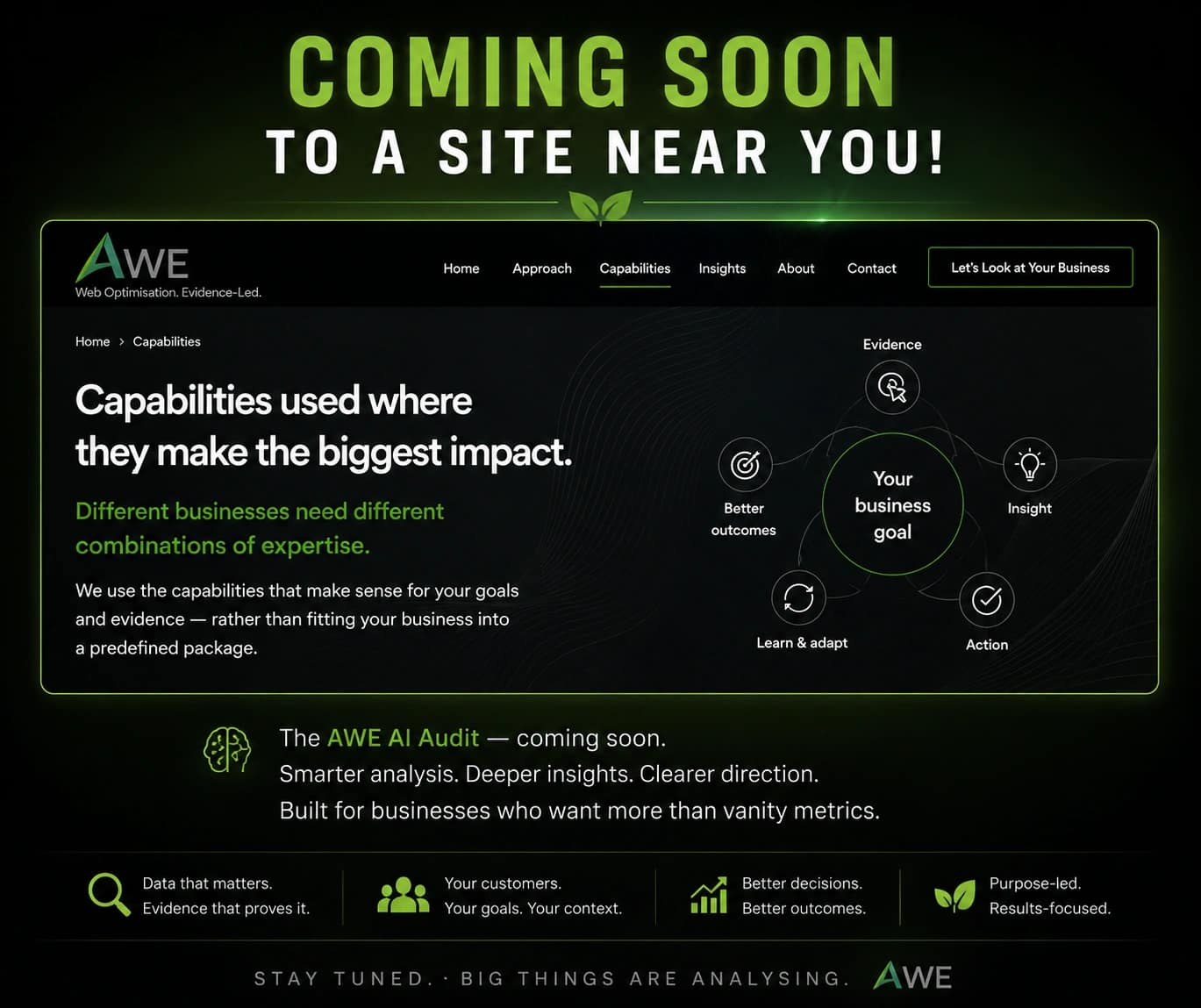
That’s also why the redesigned AWE site is moving away from presenting optimisation as a menu of predefined solutions.
The capabilities remain important.
But they sit around something more important:
Your business goal.
Evidence → Insight → Action → Learn & Adapt → Better Outcomes
Not because every business needs every AWE capability.
Quite the opposite.
Different businesses need different combinations of expertise.
The objective isn’t to sell every capability we possess.
It’s to understand the problem well enough to know which ones actually belong in the solution.
And that’s part of what the new AWE website is being designed to communicate.
It also explains the thinking behind the new AWE positioning:
AWE – Web Optimisation. Evidence-Led.
Different capabilities. One business system. Evidence determining where each can make the biggest impact.
Coming soon to a site near you.
🔗 Follow AWE on LinkedIn: https://www.linkedin.com/company/awe-conversion
🔹 Follow the discussion on Facebook for daily AWE strategies: https://www.facebook.com/awe.conversion