Most products take time to succeed, or sometimes fail, not because they lack functionality.
This often happens because adoption is a system, not a button.
Years ago, platforms like Zocdoc helped change how people booked medical appointments in the US.
But what made the platform grow wasn’t simply “having an app.”
It was the ecosystem around it.
Patients increasingly became aware of the:
- Convenience
- Availability
- Reduced friction
- Easier scheduling
- Social proof and reviews
Over time, that awareness started influencing behaviour.
And once patients began expecting that convenience, clinics and doctors increasingly had stronger reasons to participate too. That’s the important part.
The onboarding journey didn’t begin when a doctor was asked to join the platform.
It began much earlier:
- Through visibility
- Trust
- Repeated exposure
- User expectations
- Credibility signals
- Conversations happening across multiple channels
In many ways, this reflects a broader shift happening online today.
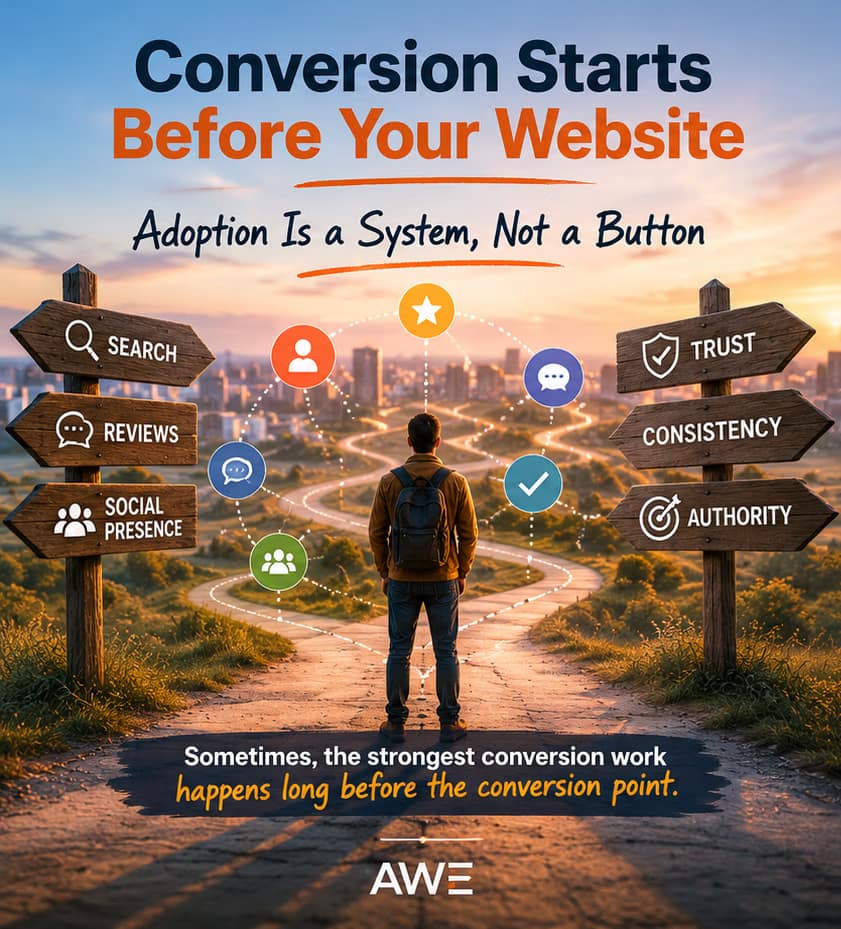
Conversion no longer starts at the signup or booking page.
People increasingly build trust before they ever contact a business, they:
- Search
- Compare
- Validate reviews
- Check social presence
- Observe consistency
- Evaluate authority subconsciously
That’s why modern SEO alone is rarely enough.
Visibility helps.
But visibility without trust, consistency, and ecosystem alignment creates weak conversion.
This is also why EEAT and conversion thinking are becoming increasingly interconnected.
Not because “AI and Google changed everything overnight.”
But because modern users increasingly expect businesses to demonstrate:
- Credibility
- Clarity
- Lived experience
- Trust consistency across platforms
The interesting part is that systems thinking explains this very naturally.
Trying to force adoption directly is often weak leverage.
But influencing awareness, trust, perceived usefulness, and ecosystem behaviour can gradually shift the entire system itself.
In other words, sometimes, the strongest conversion work happens long before the conversion point itself.
That’s also one of the core ideas behind AWE:
helping businesses grow by aligning trust, visibility, structure, and conversion into one connected system.
Interestingly, this philosophy was already part of AWE long before AI visibility became a mainstream topic.
AWE originally began as a system built to help grow a personal side business, and gradually evolved into helping other businesses align trust, visibility, structure, and conversion together.
Not treating SEO, trust, conversion, authority, content or user behaviour, as isolated activities…
🔗 Follow AWE on LinkedIn: https://www.linkedin.com/company/awe-conversion
🔹 Follow the discussion on Facebook for daily AWE strategies: https://www.facebook.com/awe.conversion