
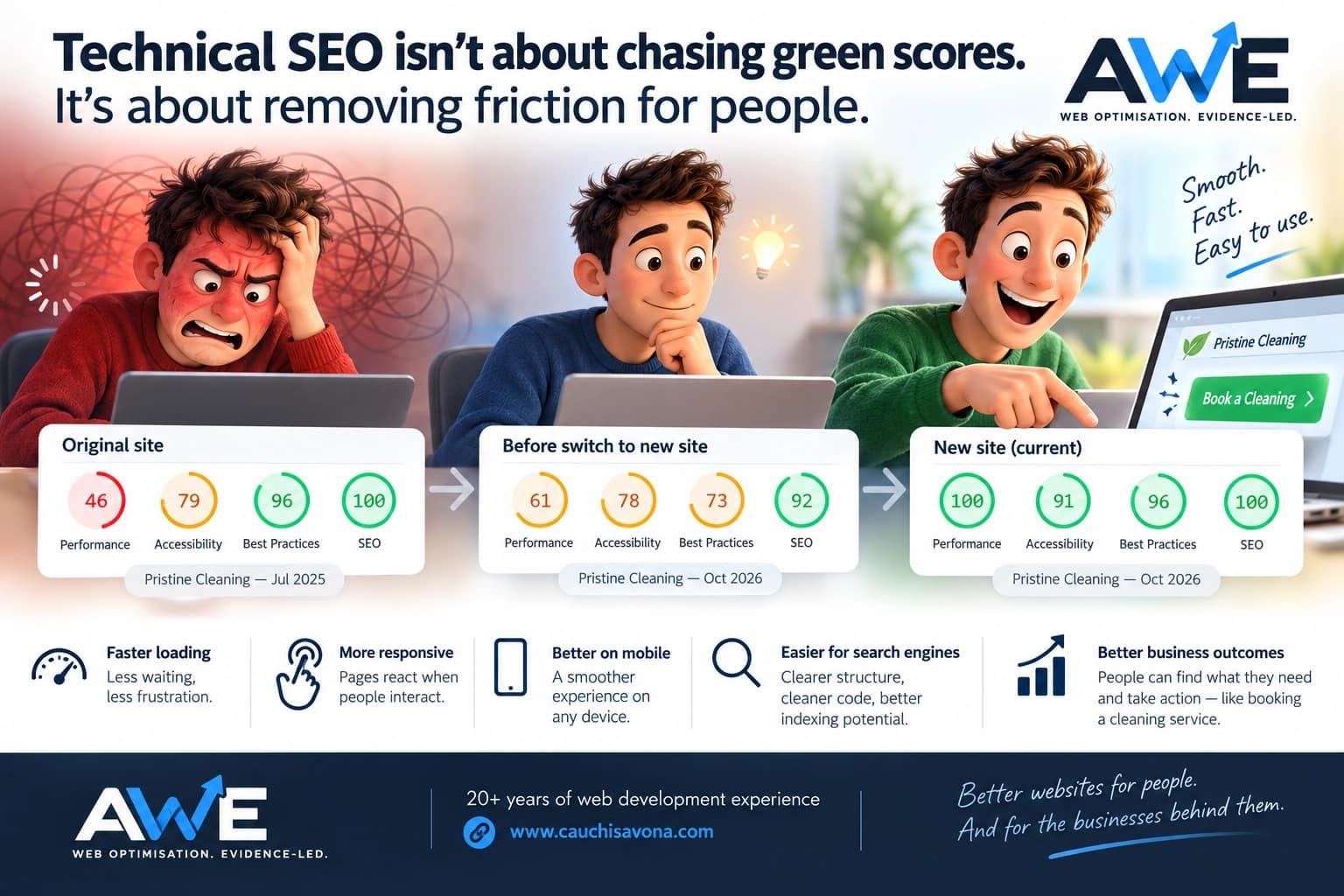
Technical SEO: Are We Building Websites for Google or for People?
Stop chasing green scores. Start removing friction.
A recent Search Engine Land article by Helen Pollitt raises an important issue: technical SEO teams can waste considerable time resolving automated audit warnings without considering their actual impact.
Imagine two findings:
– A decorative footer icon missing alternative text.
– A JavaScript-heavy page that delays a customer’s response when they press the booking button.
Both might appear in an audit. But do they deserve equal attention?
Technical SEO isn’t about clearing warnings. It’s about identifying what actually matters.
Search Engines Need More Than Speed
Technical SEO establishes the foundations that help search engines discover, crawl, render and index website content.
That means understanding robots.txt, XML sitemaps, canonicalisation, HTTP status codes, JavaScript rendering, internal linking and indexing directives.
A fast website with an accidental noindex directive can still disappear from search results.
And a perfectly indexable page can still frustrate its visitors.
Crawlability, indexability and usability are related, but they aren’t interchangeable.
Google repeatedly encourages website owners to create helpful, reliable, people-first content. Its guidance also emphasises a good overall page experience.
The underlying principle is straightforward: make websites useful to the people they’re intended to serve.
What Core Web Vitals Actually Measure
Google’s three Core Web Vitals help quantify important aspects of that experience:
- Largest Contentful Paint (LCP): How quickly the main content becomes visible. Good: 2.5 seconds or less.
- Interaction to Next Paint (INP): How responsive the page feels when someone interacts with it. Good: 200 milliseconds or less.
- Cumulative Layout Shift (CLS): How much the layout unexpectedly moves. Good: 0.1 or less.
These thresholds are evaluated at the 75th percentile of visits.
Google’s Chrome User Experience Report (CrUX) provides field measurements from eligible real Chrome users, while Lighthouse provides controlled laboratory diagnostics.
The distinction matters.
A PageSpeed Insights performance score of 93 is encouraging, but it doesn’t automatically mean the page passes all three Core Web Vitals in real-world use.
A green score is evidence, not the objective.
A Practical Example: Pristine Cleaning
While developing the new Pristine Cleaning website, we applied a lightweight, modular approach informed by previous development work.
The reported PageSpeed Insights performance result was 93, with the other Lighthouse categories also scoring in the 90s.
Encouraging results, but not proof of improved rankings or conversions.
The objective was not to chase a particular number.
It was to build an efficient website where visitors could understand the services, navigate comfortably and request a quotation without unnecessary obstacles.
The performance result gives us useful technical evidence. Actual visitor behaviour and business outcomes require further measurement.
Where Development Meets SEO and CRO
This is where more than twenty years of web development experience becomes particularly valuable to my work at AWE.
SEO helps establish discoverability. CRO examines whether visitors can accomplish meaningful goals. Web development provides the technical foundations to support both.
A fast website can still communicate poorly.
A persuasive website can still be technically inaccessible.
And not every audit warning deserves developer time.
The real skill lies in distinguishing technical defects from low-impact noise, then prioritising improvements according to evidence and business value.
Google needs to access and understand our pages.
People need to find them useful.
Neither requirement should be ignored.
The goal isn’t to impress Google with a perfect score.
It’s to build websites that work, for search engines, for people and for the businesses behind them.
Further reading
Google – Technical Requirements for Searchrspective on using search questions and modifiers to uncover people’s needs, concerns, comparisons and stages of their journey.
Helen Pollitt — The Biggest Technical SEO Time-Wasters to Avoid
Google – Creating Helpful, Reliable, People-First Content
Google – Understanding Core Web Vitals
🔗 Follow AWE on LinkedIn: https://www.linkedin.com/company/awe-conversion
🔹 Follow the discussion on Facebook for daily AWE strategies: https://www.facebook.com/awe.conversion